
Blog

7 Best PES Membrane Filters for Global Buyers

Choosing a filter is rarely just a pore-size decision. In laboratories, pharmaceutical production, and water treatment, membrane material can affect flow, compatibility, and process consistency. Pes Membrane filters are valued for their hydrophilic character and relatively low protein binding, but performance still depends on the specific application. Small details matter. A housing connection, wetting step, or sterilization method can change how a filter performs in practice.

Industry forecasts offer useful context, but they should not be mistaken for product testing. MarketsandMarkets’ Membrane Filtration Market report estimated the global market at USD 17.3 billion in 2023 and projected USD 25.8 billion by 2028. That figure covers membrane filtration broadly, not PES filters alone. It signals growing demand, while leaving buyers to verify application-specific claims against technical datasheets and validation documents.

This guide compares seven PES membrane filter options for global buyers. It focuses on practical selection criteria: pore size, flow rate, chemical compatibility, available formats, and supplier documentation. Buyers should also check whether stated performance applies to the complete filter assembly or only the membrane sheet. That distinction is easy to miss. No single product suits every process, and published specifications cannot replace testing with the intended fluid and operating conditions. A careful comparison can narrow the shortlist; final qualification still belongs to the user’s process.
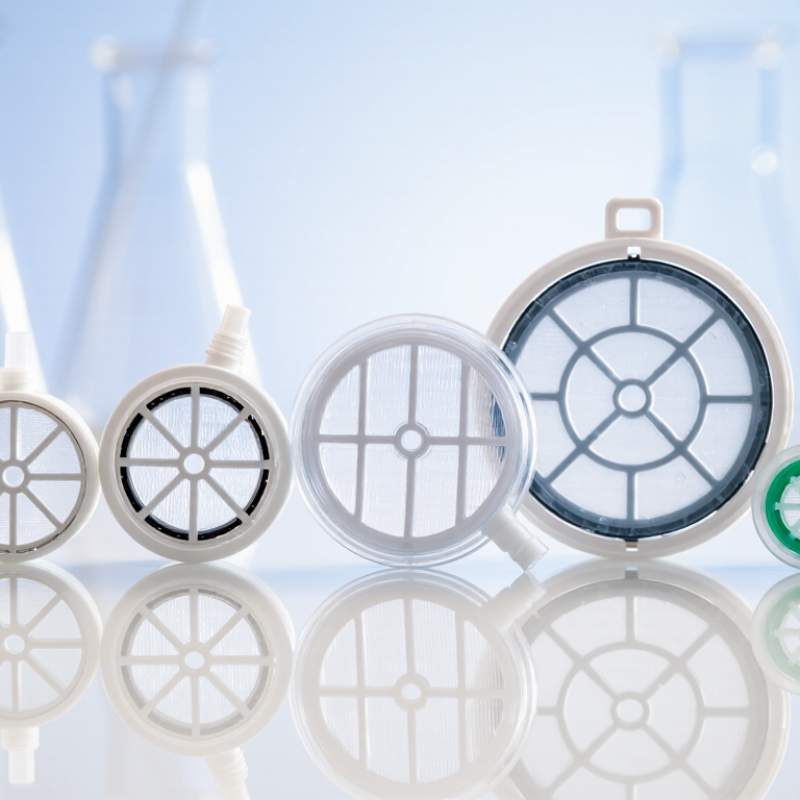
7 Best PES Membrane Filters for Global Buyers

PES Membrane Basics: Hydrophilic Polymer and Low Protein Binding

PES, or polyethersulfone, is a hydrophilic polymer that wets readily with water. This helps aqueous samples pass through without a prolonged pre-wetting step. PES is also selected for relatively low protein binding, which can help preserve sample recovery. Low does not mean zero. Protein adsorption still varies with the molecule, pH, and solution composition. A small filter can matter when the sample is precious.

Grand View Research estimated the global membrane filtration market at USD 17.62 billion in 2023, with a projected 7.8% compound annual growth rate from 2024 to 2030. This is a broad market estimate, not a PES-specific sales figure. For global buyers, compare pore size, housing compatibility, sterilization method, and validation documents—not polymer name alone. Check recovery with the actual protein solution; catalog claims may not predict your process perfectly.

Tips: For a quick bench check, filter a measured protein sample and compare its concentration before and after filtration. Record the filter area and sample volume. Small details count.

Pore Ratings Explained: 0.1, 0.2, and 0.45 μm Applications

Pore size is a practical starting point, not a complete performance guarantee. A 0.45 μm PES membrane is commonly used to clarify liquids and reduce visible particles before analysis or downstream processing. It may suit a cloudy buffer, but it should not be treated as a sterilizing filter. Check the membrane’s retention data and the fluid’s particle load; a filter can clog sooner than expected.

For finer filtration, 0.2 μm membranes are widely selected when bacterial retention is required in a validated process. The exact rating may be listed as 0.2 or 0.22 μm, depending on the product specification. Do not assume the numbers alone prove sterility. The full filter assembly, operating conditions, and validation method matter. Small details matter.

A 0.1 μm PES membrane can retain smaller particles than a 0.2 μm option, but it may also reduce flow and reach higher pressure sooner. That trade-off is easy to underestimate. For viscous samples or large volumes, test the intended liquid and monitor pressure during use. Also confirm chemical compatibility, temperature limits, and whether the stated pore rating is nominal or absolute. I would not choose by pore size alone; sometimes the “finer” option creates a less reliable workflow.

7 Best PES Membrane Filters for Global Buyers — Pore Ratings Explained: 0.1, 0.2, and 0.45 μm Applications

A practical comparison of common PES membrane filter configurations. Selection depends on the liquid, required throughput, operating pressure, and the filter’s validated performance.

Filter Option Pore Rating Typical Format Common Applications Why Choose It Important Consideration
Fine-retention PES syringe filter 0.1 μm Small-area syringe filter Small-volume filtration when finer particle or microbial retention is required; may be used in mycoplasma-reduction workflows. Useful for processing small samples with a finer nominal pore rating than 0.2 or 0.22 μm. Do not assume mycoplasma removal or sterilization without product-specific validation for the intended process.
Fine-retention PES disc membrane 0.1 μm Flat disc for a compatible holder Laboratory-scale filtration, process development, and applications requiring finer clarification or microbial reduction. Can be used with reusable holders and offers a larger filtration area than many syringe formats. Confirm holder compatibility, pressure limits, and retention claims; finer pores can reduce flow and increase clogging.
General-purpose PES syringe filter 0.2 or 0.22 μm Small-area syringe filter Small-volume filtration of aqueous buffers, media, and other compatible solutions. Convenient for routine laboratory sample preparation and small batches. A 0.2 or 0.22 μm rating alone does not establish sterilizing-grade performance; use a validated filter when sterility is required.
General-purpose PES disc membrane 0.2 or 0.22 μm Flat disc for a compatible holder Bench-scale filtration of aqueous solutions, including buffer and media preparation. Provides a flexible membrane format for different holder sizes and laboratory setups. Check the membrane’s effective area, recommended pressure, and compatibility with the solution.
PES bottle-top filter 0.2 or 0.22 μm Disposable bottle-top vacuum unit Clarification or filtration of laboratory aqueous solutions into a receiving bottle. Combines a filter membrane and receiving vessel for convenient batch handling. Confirm the unit’s capacity and vacuum limits; performance varies by membrane area and device design.
PES capsule filter 0.2 or 0.22 μm Single-use capsule Small- to medium-scale processing of aqueous solutions in laboratory or pilot workflows. Enclosed construction can simplify installation and handling compared with a flat membrane in a reusable holder. Size the filter for the batch volume and expected solids load; verify connections, pressure limits, and integrity-testing options.
Coarse-clarification PES syringe or disc filter 0.45 μm Syringe filter or flat disc Prefiltration and particle clarification of relatively clean aqueous samples before a finer filtration step. Typically offers less flow resistance than finer-rated membranes when the liquid and filter area are comparable. Not a sterilizing-grade choice by pore rating alone; it may not retain bacteria or fine particles reliably.

Selection note: PES is a hydrophilic membrane material commonly used for aqueous solutions and is often selected for its relatively low protein binding. Actual binding, flow, chemical compatibility, and retention depend on the specific membrane and test conditions. Pore ratings and sterilizing-grade claims should be confirmed in the manufacturer’s product documentation and validated for the intended process.

Seven PES Filter Types Compared by Format, Diameter, and Pore Size

PES membrane filters come in several formats, and dimensions affect handling as much as flow. Syringe filters commonly use 13, 25, or 33 mm discs for small-volume samples. Larger disc filters, often 47 or 90 mm, fit holders used for batch work. Check the stated active filtration area, not just the outer diameter. Small detail, but it matters.

Seven common types include syringe, disc, capsule, cartridge, flat-sheet, bottle-top, and inline filters. Syringe and disc versions are selected by diameter and pore size, often 0.1, 0.2, or 0.45 micrometres. Capsules and cartridges provide more membrane area for larger volumes; their dimensions depend on housing design. Flat sheets are cut to fit equipment, while bottle-top formats attach to matching receivers. Inline filters are chosen by connection size and available flow path, so pore size alone is not enough.

Pore selection should match the task and the system’s validation requirements. A 0.2-micrometre membrane is commonly chosen for sterilizing-grade filtration, while 0.45-micrometre pores suit many clarification steps. Smaller pores can slow flow, especially with cloudy or viscous samples. Not every format is interchangeable. Compare diameter, housing connections, effective area, and documented compatibility before ordering; supplier specifications can differ, and that is easy to overlook.

Selection Criteria: Flow Rate, Chemical Compatibility, and Sterilization Rating

Choosing a PES membrane filter starts with the liquid and the required throughput. Flow rate depends on pore size, membrane area, pressure, and sample viscosity. A high advertised rate may come from water testing, not a protein-rich buffer. Compare data measured under conditions close to your process. Small details matter. Check whether the stated flow is initial or sustained, and whether the test used the same housing size.

Chemical compatibility deserves a separate check. PES suits many aqueous solutions, but solvents, extreme pH, or additives can change performance. Review the filter’s compatibility data for the exact formulation and contact time. Sterilization ratings also need careful reading: confirm the validated method, temperature, duration, and number of cycles. A filter rated for autoclaving may not tolerate repeated cycles in your setup. Do not assume that a sterilizing-grade pore rating alone proves a complete process; confirm the relevant validation documents. A short trial with the actual liquid can reveal slower flow, leakage, or unwanted binding. These checks take time, and it is easy to overlook one. Yet the best choice is usually the filter whose documented limits match the real process, not the one with the most impressive single specification.

Global Buying Checks: Quality Systems, Validation, and Supplier Documentation

Global buyers evaluating PES membrane filters should look beyond pore size and flow rate. A controlled quality system should link incoming materials, production records, and finished-filter release checks. Ask for the certificate’s current status and scope; a certificate alone does not prove that every filter application is suitable. Lot-level traceability matters. It helps connect a filter package to manufacturing and test records when questions arise.

Tips: Request a sample lot record, integrity-test method, and change-notification policy. Check that document revisions match the products being quoted.

Validation evidence should reflect your process conditions, not just a supplier’s general claims. Review compatibility data for the intended fluid, temperature, and sterilization method. Ask how extractables, bacterial retention, and filter integrity were evaluated, and whether the test setup resembles your use. Supplier documentation may include protocols, reports, specifications, and handling instructions. Read the limits carefully. Some data may be available only for defined conditions, and that gap deserves a follow-up question. A tidy document package is reassuring, but it is not a substitute for reviewing the actual methods and results. Buyers can also compare response times and technical support before placing a large order; this step is easy to overlook.

Article Source: