
Wholesale buying requires more than attractive colors and low unit prices. Bubble Wands must perform consistently, pack efficiently, and remain suitable for their intended age group. Grand View Research valued the global toys market at approximately USD 108.7 billion in 2023, with continued growth projected through 2030. However, that report covers the broader toy sector, not Bubble Wands specifically. This distinction matters.
The Toy Association identifies outdoor play, sensory engagement, and affordable novelty as important toy-purchasing influences. Circana’s global toy industry reports also show that value-conscious shoppers increasingly compare price, durability, and play value. For wholesale buyers, one cracked handle can become a carton of returns. A leaking bubble solution bottle can damage nearby inventory. Small details matter.
Joan Lawrence, a former toy-safety specialist at The Toy Association, has emphasized: “Safety is not an option; it is a requirement.” Buyers should therefore examine materials, age labeling, packaging strength, leak resistance, and supplier documentation. Ask for samples. Test the wand outdoors. Check how many bubbles it creates after repeated dipping. Do not trust photographs alone. Sometimes, the cheapest offer is the most expensive mistake. These ten buying tips combine practical sourcing experience, industry guidance, and measurable quality checks. They are not a perfect formula. Product testing can still expose weaknesses that spreadsheets miss. Yet careful evaluation gives wholesalers stronger evidence before placing large orders.
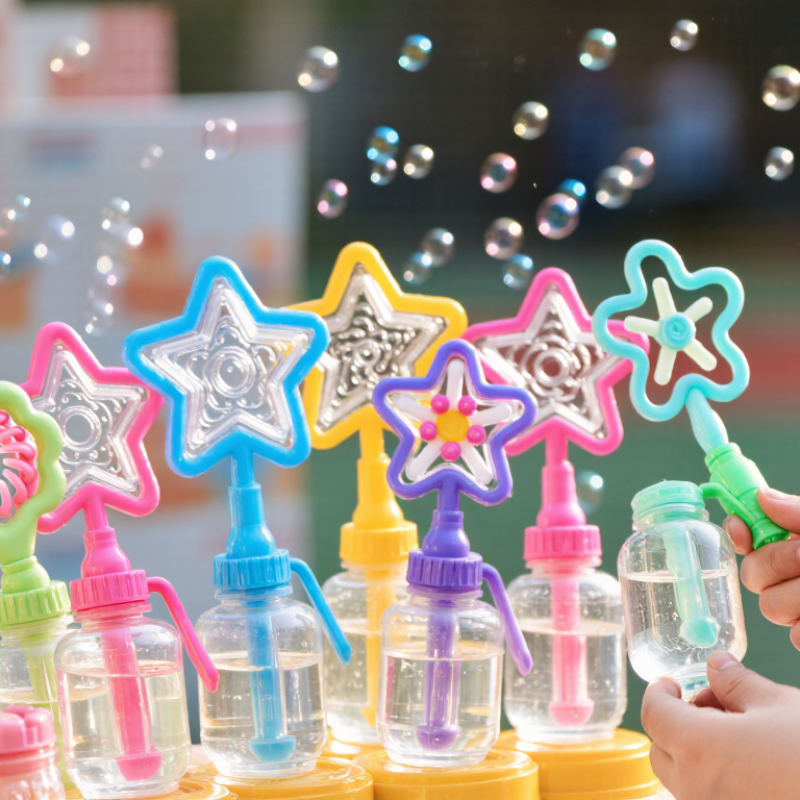
Before requesting wholesale quotes, define where and how the bubble wands will be used. A party store may need bright colors and compact packaging. An event supplier may prefer larger wands for outdoor demonstrations. Record the target age range, sales channel, season, and expected order volume. Small details affect the final cost.
Specify the wand’s length, handle shape, loop design, and liquid capacity. Ask for sturdy plastic or other suitable materials with smooth edges. The handle should feel comfortable during repeated use. Request sample units before approving a large order. Check for loose parts, sharp edges, weak joints, and leaking containers. Do not rely on photographs alone.
Packaging needs equal attention. State the units per inner box, carton dimensions, labeling space, and preferred color ratio. Confirm the minimum order quantity, production time, sample charges, and shipping terms in writing. Request material details and applicable safety documents for your market. A supplier’s inspection record can reveal more than a polished catalog. I once underestimated carton size, and storage costs rose quickly. That mistake was avoidable. Leave room for damaged units, seasonal demand, and slower sales. A practical starting estimate is useful, but it should not become a rigid promise. Recheck the quantities after testing samples and reviewing customer feedback.
For wholesale buyers, material choice shapes durability, handling, and bubble output. Polypropylene wands are lightweight and resist moisture during storage. ABS handles repeated use better, but it can feel less flexible. Silicone elements add a softer grip and reduce sharp contact points. They may, however, collect dust in warehouse cartons. Ask suppliers for material details and batch inspection records.
Design affects performance more than many buyers expect. A wide ring creates larger bubbles, but it needs a steady air stream. Smaller rings produce many quick bubbles and suit party packs. Multiple ring shapes can increase visual variety, though they may slow assembly and raise packaging costs. Check the handle length, ring thickness, and connection strength. A loose ring is a poor surprise.
Test samples with the same bubble solution. Count bubble size, output, and usable minutes per wand. Do this indoors and outdoors. Wind changes the result. My early buying mistake was judging performance from one demonstration. The solution was unusually fresh, so the sample looked better than the later shipment. Now, I test three batches and record results with simple phone videos. Request packed samples too. A strong design can still arrive scratched or bent when cartons are crowded. Make space for buyer feedback, because the best-looking wand may not be the easiest one to use.
A bubble wand is a children’s product, not merely a low-cost party accessory. Wholesale buyers should request test reports for the wand, cap, packaging, and bubble solution. Check applicable requirements, such as ASTM F963, EN 71, or ISO 8124. Requirements vary by destination. That detail is easy to miss.
The U.S. Consumer Product Safety Commission reported more than 230,000 toy-related emergency-room injuries among children under 15 in 2023. This figure shows why small design details matter. Inspect sharp seams, loose handles, brittle plastic, and detachable caps. A practical sample test includes repeated twisting, dropping, and opening by hand. The liquid also needs chemical and microbiological testing. Ask for evidence covering heavy metals, restricted plasticizers, preservatives, and contamination. Do not rely only on a supplier’s general certificate.
EU Safety Gate recorded 3,412 product alerts in 2023, with toys representing about 13% of notifications. Its data highlights the value of traceability and corrective action. Request batch numbers, laboratory accreditation, production dates, and retained samples. Verify that the report matches the exact model and liquid formula. A photograph is not proof. I have seen buyers overlook the refill bottle because the wand looked harmless. That assumption needs challenging. If documentation is incomplete, pause the order and obtain independent testing before shipment.
10 Bubble Wands Buying Tips for Wholesale Buyers
A reliable supplier should provide factory details, production photos, test reports, and clear contact information. I request samples from at least three suppliers before discussing volume. Check the wand’s handle grip, bubble opening, cap fit, and liquid leakage after repeated use. Small defects become expensive when cartons arrive. Circana reported that global toy sales fell 7% in 2023, reaching $108.7 billion. That pressure makes supplier pricing attractive, but quality shortcuts can damage your margins.
Ask about customization early. Confirm logo methods, color matching, packaging size, carton strength, and artwork approval steps. A supplier may accept a low minimum order for plain products but require a higher MOQ for printed packaging. Get every charge in writing, including mold fees, sample fees, setup costs, and replacement terms. Custom colors can also change the production schedule. Sometimes, the “small” change is the costly one.
Compare the MOQ with your realistic sales forecast, not your ambition. I prefer a pilot order before committing to a large shipment. The Toy Association’s industry reporting continues to emphasize value, playability, and product safety as important purchasing factors. Request material specifications and applicable laboratory testing records for your destination market. Ask how rejected units are counted. Weak answers matter. A spreadsheet will not reveal every manufacturing problem. I still inspect random cartons personally, because supplier promises are useful, but physical evidence is better.
Wholesale buyers should price bubble wands from landed cost, not factory cost alone. Record unit price, carton quantity, inspection fees, inland transport, freight, insurance, duties, and payment charges. Then add a realistic margin. The 2023 Grand View Research report estimated the global toys market at over US$100 billion, with continued growth expected. Competition is strong, but low pricing can hide weak materials or expensive replacements. Compare at least three quotations. Check bubble output, handle strength, leakage, color consistency, and packaging damage. Ask for test samples before confirming volume. Small details matter.
Shipping can quietly remove your profit. Measure carton dimensions and gross weight, because freight often uses whichever calculation is higher. Request both sea and air quotations. The World Bank’s 2023 Logistics Performance Index showed major differences in customs efficiency and delivery reliability across markets. Build a delay allowance into your launch calendar. Confirm pallet limits, carton labels, moisture protection, and port charges in writing. A spreadsheet helps, but it can still be wrong.
Long-term value means fewer complaints and steadier repeat orders. The 2023 OECD product durability guidance emphasizes repairability, reliability, and lifecycle thinking. For bubble wands, inspect cap fit, wand seams, and liquid-contact materials. Estimate breakage using a pilot order, not optimism. Track return rates after the first shipment. Ten percent savings on purchase price may disappear through replacements, slow sales, or damaged cartons. I would also review the calculation after every shipment, because the first forecast is rarely perfect.