What Is a Fragrance Diffuser Stick and How Does It Work?
A Fragrance Diffuser Stick offers a quiet way to scent a room without flames, batteries, or visible mist. It usually combines a glass vessel, scented diffuser oil, and porous rattan or fiber sticks. The sticks stand upright, often beside a window or on a hallway shelf. Their tiny channels absorb the oil and carry it upward through capillary action. Once the oil reaches the exposed surface, fragrance slowly evaporates into the surrounding air.
Aroma educator and author Karen Gilbert explains, “Reed diffusers use capillary action to draw fragrance up the reeds and release it into the air.” This simple process explains why stick material, oil thickness, room temperature, and airflow affect performance. Thinner oils may travel faster. Warm air can increase evaporation. Strong drafts may consume the fragrance too quickly.
Small details matter.
Turning the sticks every few days can refresh the scent, but it may also shorten the diffuser’s lifespan. More sticks do not always create a better experience. They can produce an overpowering room and waste oil. A well-designed Fragrance Diffuser Stick should feel steady, not aggressive. Still, personal preference complicates every recommendation. A citrus blend may feel clean in a kitchen, while amber or cedar may seem heavy there.
This guide examines how diffuser sticks work, what components influence their performance, and how to use them thoughtfully. It also considers common expectations that are not entirely accurate. A diffuser cannot scent every room equally. Placement remains important.
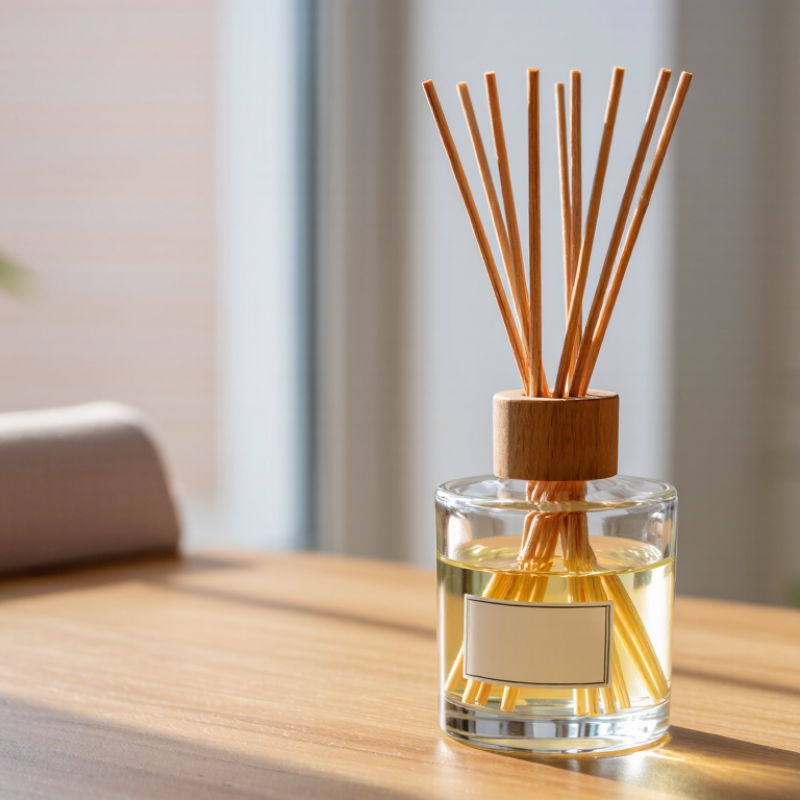
What Is a Fragrance Diffuser Stick? Definition and Core Function
A fragrance diffuser stick is a porous reed placed in scented liquid, usually held in a narrow-necked vessel. It acts as both a wick and a passive delivery tool. Liquid travels up tiny channels in the stick through capillary action, then evaporates from the exposed surface into the surrounding air. No flame is needed. The scent spreads gradually, rather than arriving in a brief burst.
The mechanism is simple, but not perfectly predictable. Stick material, room temperature, airflow, and liquid formulation all affect how quickly fragrance is released. For example, a reed near a warm, moving-air vent may dry faster than one on a cool shelf. Turning the sticks can expose a freshly wetted surface, though it may also make the scent stronger for a while. That trade-off is easy to overlook.
Market data helps explain why this format matters, though it does not measure diffuser performance itself. Grand View Research estimated the global home fragrance market at USD 9.2 billion in 2023 and projected growth through 2030. A large category does not mean every product works equally well. For a fair comparison, pay attention to room size, ventilation, and how long the sticks remain evenly saturated. The liquid level is only a rough clue.
Key Components: Reeds, Fragrance Oil, Solvent, and a 15–30% Scent Load
A fragrance diffuser stick is a porous reed that draws scented liquid upward and releases aroma into the air. Rattan reeds have tiny channels that help the liquid travel from the bottle to the exposed tips. No flame or heating is needed. The scent spreads as the liquid evaporates, so room temperature and airflow can affect how noticeable it feels.
A typical blend contains reeds, fragrance oil, and a solvent. Fragrance oil provides the scent; the solvent dilutes it and helps the mixture move through the reeds. A scent load of 15–30% means fragrance oil makes up roughly that share of the finished blend, though exact measurements depend on the formula. More oil does not always mean better performance. A dense blend may travel slowly, while a very light one may fade quickly. Small differences matter.
Tips: Start with fewer reeds in a small room, then add more if the scent seems faint. Turn the reeds over outdoors or over a paper towel to reduce drips. Keep the bottle on a stable, protected surface. I have found that airflow changes the result more than expected; a diffuser near a draft may empty sooner, though the scent can still seem uneven.
Step One: Capillary Action Wicks Fragrance Through Porous Reeds
A fragrance diffuser stick works through capillary action: liquid moves through tiny spaces in a porous reed. The lower end sits in scented oil, and the liquid gradually climbs toward the exposed tip. No pump is involved. Look closely at a dry reed, and its narrow channels are invisible, but they help draw the fragrance upward.
As the oil reaches the reed’s surface, some of its more volatile ingredients evaporate into the surrounding air. Air movement carries those molecules across a room, though the scent is usually strongest near the diffuser. Warmth and airflow can make evaporation faster. A cool, still room may produce a gentler scent. It is not a perfectly steady process; the aroma can seem stronger on some days than others.
The reeds matter. If they are damp or clogged with dust, less liquid may travel through them. Turning them over can expose a freshly wetted end, but it may also briefly intensify the scent. I’ve found that this small change is easy to overlook. Start with a few reeds, then adjust based on the room. More reeds generally expose more surface area, but they also use the oil faster. Keep the container upright, and avoid placing it beside a heater or an open window. Even careful setup cannot make fragrance spread evenly everywhere.
Step Two: Reed Surface Area and Evaporation Release Scent into Air
A reed diffuser works through capillary action: fragrance liquid moves up tiny channels inside each stick. At the exposed end, the liquid evaporates and releases aromatic molecules into the room. More exposed reed surface can mean faster evaporation and a stronger scent, though the relationship is not perfectly predictable. A wide bundle may scent a small room quickly, but it can also use the liquid faster.
Reed material and thickness matter. Porous reeds with open channels often draw liquid more readily than dense, coated sticks. Room conditions matter too. Warm air and steady airflow can carry scent farther, while a cool, still corner may keep it close to the vessel. Place the diffuser away from direct sunlight, heaters, and busy drafts to help moderate evaporation. It is easy to assume more reeds are always better. They are not. Start with a few, then add one if the fragrance seems faint after several hours.
Turning reeds over exposes the damp ends and can briefly increase scent release. The effect may fade, and frequent flipping can speed liquid loss. I have found the first impression after turning them can be stronger than the room’s scent later; that difference is worth noticing. If the aroma becomes too intense, remove a reed or two rather than moving the vessel near heat. Keep the sticks upright and the container stable. Small adjustments are usually more useful than expecting a fixed number of reeds to suit every room.
Performance Factors: Temperature, Humidity, Airflow, and 100–200 mL Refills
A fragrance diffuser stick is a porous reed placed in scented liquid. The liquid travels up the stick and evaporates from its exposed surface, releasing scent into the room. It needs no flame or power. Simple, but not perfectly predictable: two identical-looking rooms can produce different results.
Temperature affects evaporation. A warm sunny shelf may make the scent stronger at first, while using the liquid faster. Cool rooms usually release fragrance more slowly. Humidity can also change how quickly the liquid evaporates, though the effect depends on the formula and room conditions. Airflow matters, too. A gentle draft can help carry scent across a space; strong airflow near a vent may use up the refill unevenly. Placement takes a little trial and error.
Refill size influences how long the diffuser can operate, but 100–200 mL is not a fixed runtime. A 100 mL refill may suit a small room or a lighter scent preference. A 200 mL bottle offers more liquid for a larger space or longer use, yet performance still depends on temperature, airflow, and the number of sticks. Start with fewer sticks. Wait several hours, then adjust if the scent feels faint. Turning sticks over can briefly boost fragrance, but it may increase evaporation. Keep the bottle upright on a stable surface, away from heat, direct sun, and busy walkways. A paper note nearby can help track refill use. Simple, and surprisingly useful.