How to Source Crystal Scented Candles for Wholesale?
Sourcing a Crystal Scented Candle for wholesale involves more than choosing attractive stones and pleasant fragrances. Buyers must assess wax quality, crystal authenticity, scent performance, packaging strength, and supplier consistency. A polished amethyst may look beautiful under warm light, but it cannot compensate for tunneling, weak fragrance throw, or an unstable wick.
David Gadd, a respected candle-industry educator and founder associated with Candle Shack, offers a practical reminder: “A beautiful candle still has to burn safely and consistently.” This principle should guide every supplier conversation. Request product samples before discussing large quantities. Test each candle in a ventilated room. Record melt-pool depth, burn time, soot, vessel temperature, and fragrance strength. Small details matter.
Ask suppliers about wax composition, fragrance specifications, crystal sourcing, batch controls, and safety testing. Confirm the minimum order quantity, lead time, private-label options, carton protection, and replacement policy. A reliable manufacturer should provide clear documentation without avoiding difficult questions. For wholesale buyers, consistency often matters more than a dramatic first sample.
There is a common mistake here.
Many buyers focus too heavily on visual trends. Crystal color can change slightly between batches, and natural inclusions are not always defects. However, unclear grading standards may create customer complaints. Define acceptable variations in writing. Compare at least three suppliers, inspect production samples, and calculate the true landed cost before committing. The best Crystal Scented Candle supplier combines dependable craftsmanship, transparent communication, and repeatable performance. No single checklist guarantees success, but careful testing reduces expensive surprises.
Define Your Wholesale Crystal Candle Requirements
Define Your Wholesale Crystal Candle Requirements
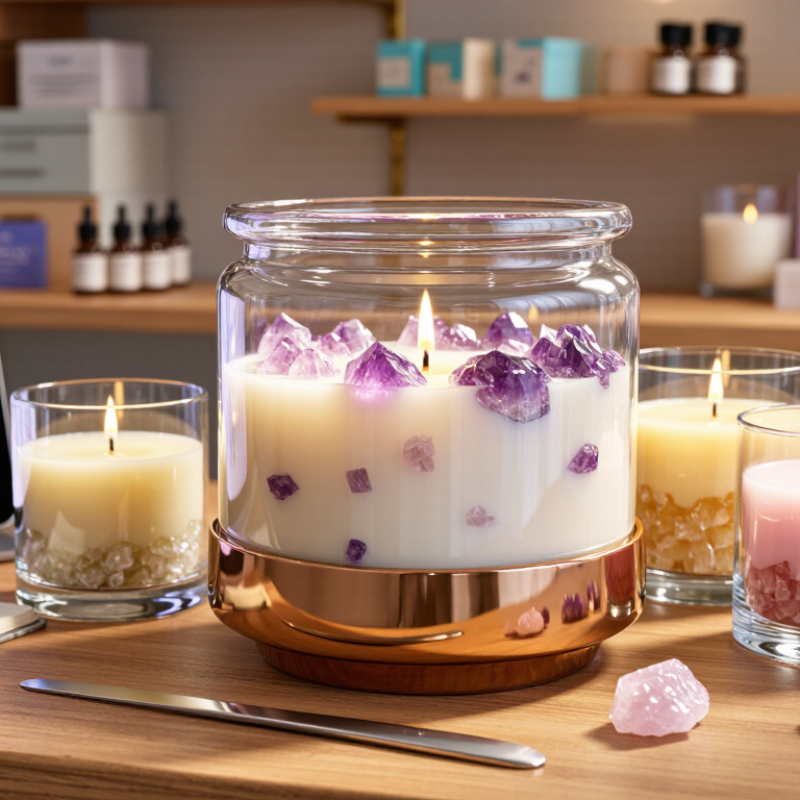
Before contacting suppliers, write down what the candle must deliver. Choose the crystal type, wax, fragrance strength, container size, and intended use. For example, a 200-gram candle in a clear glass jar may suit gift shops, while a smaller tin can work for travel sets. Decide whether each candle needs one crystal or several, and specify their size and placement. Crystals should be securely embedded or arranged so they do not interfere with safe burning. Ask for product specifications and sample photos, but assess a physical sample before approving an order.
Set practical limits for price, order quantity, lead time, and packaging. Request the unit price at different quantities, along with details about labels, carton dimensions, and protective inserts. Fragrance preferences can be subjective. A scent that seems subtle in a sample may feel strong in a small room, so test it in the setting where customers are likely to use it. I once overlooked carton strength in a planning checklist; it mattered more than expected.
Tips: Test samples for scent throw, wax appearance, and crystal stability. Record what you notice. Ask the supplier to confirm any unclear detail in writing, especially sample-to-bulk consistency and acceptable variations. A slightly imperfect sample is useful feedback: note the issue, request an adjustment, and review the next version before committing.
Evaluate Candle Quality, Materials, and Crystal Authenticity
Sourcing crystal scented candles for wholesale begins with a close quality inspection. I examine the wax surface for cracks, sinkholes, frosting, or uneven coloring. A smooth top is useful, but it is not enough. I also request a controlled burn test from the supplier. The flame should remain steady, while the melt pool develops evenly without excessive smoke. Small details matter.
Materials deserve careful attention. Ask whether the candle uses soy, paraffin, beeswax, or a blended formula, then compare the stated composition with supplier documentation. Check the wick’s material, size, and placement. An oversized wick may create soot, heat, or an unstable flame. Fragrance performance should be tested in both cold and warm conditions. Some scents smell impressive at first, then fade quickly during burning. That mistake is easy to miss.
Crystal authenticity requires more than attractive photographs. Request clear images, weight details, treatment information, and any available mineral identification records. Natural inclusions, color variation, and slight shape differences can support credibility, but they do not prove origin alone. A qualified gemologist or independent testing service can provide stronger evidence for higher-value orders. I have seen polished stones described too confidently, especially when dyed or heat-treated pieces were not disclosed. That should prompt a second review. Before placing a bulk order, compare samples from different production batches. Record defects, scent strength, crystal condition, packaging damage, and burn times. Perfect samples are not always representative. Real reliability appears in the ordinary ones.
Review Pricing, Minimum Orders, and Customization Options
When sourcing crystal scented candles wholesale, compare the full landed cost, not just the unit price. Ask suppliers to separate wax, fragrance, vessel, crystal, packaging, and freight charges. The Grand View Research Candle Market Size report estimated the global candle market at USD 10.6 billion in 2023, but it does not isolate crystal candles. Treat that figure as broad market context, not proof of demand for this niche.
Request tiered quotes at several quantities, such as 100, 300, and 500 units. Minimum order quantities often vary by vessel color, fragrance, and private-label packaging. Confirm whether a sample fee is refundable and whether custom labels require a separate setup charge. Small details matter. A low unit price can hide costly packaging or freight. Get the terms in writing.
Customization can include fragrance strength, wax color, crystal placement, vessel finish, and gift boxes. Ask for a sample showing the actual crystal size and how it sits in the wax; photos can be misleading. Request fragrance documentation and batch consistency details, too. The National Candle Association notes that candle performance depends on factors such as wick, wax, and fragrance balance. Test burn samples before committing. I would not assume a popular scent will suit every customer. Ask suppliers how they handle defects, lead-time changes, and repeat orders before paying a deposit.
Place Samples, Verify Compliance, and Finalize Your Order
Order samples before discussing volume pricing. Grand View Research estimated the global candle market at US$12.88 billion in 2022, with growth projected through 2030. That broad market figure does not guarantee demand for crystal designs, so test your specific audience. Request samples from more than one supplier, then compare fragrance strength, wax finish, crystal placement, and packaging.
Burn each sample in a draft-free area and record flame stability, soot, and vessel temperature. Check whether decorative crystals shift or obstruct the wick; removable crystals may be safer and easier to explain to buyers. Small details matter. Ask for current safety data sheets, fragrance documentation, and test reports relevant to your destination market. For example, request evidence of testing against applicable candle fire-safety and labeling standards, such as ASTM F2417 and ASTM F2058. Requirements can vary by market, so verify them independently.
Before confirming quantity, approve a signed sample and specify wax type, fragrance load, vessel dimensions, crystal color, labels, and carton strength. Confirm lead time, defect tolerances, inspection method, and what happens if production differs from the approved sample. A small pilot order can reveal packaging damage or scent inconsistencies, though it may cost more per unit. Record every change in writing; verbal approvals are easy to misremember.