China Top 10 Custom Animatronics Suppliers?
Choosing among China’s top Custom Animatronics suppliers takes more than comparing prices or polished showroom videos. These machines must perform reliably in real settings, where heat, dust, repeated movement, and tight installation schedules can expose weak design choices. Custom Animatronics projects may include lifelike dinosaurs, moving figures, themed displays, or interactive exhibits. Each requires careful coordination between sculpture, mechanics, electronics, and control systems.
Garner Holt, a veteran animatronics creator, offers a useful perspective. The following is a paraphrase, not a verified verbatim quotation: “A convincing figure depends on the details guests notice—and the engineering they never see.” That distinction matters. A creature’s skin texture may look impressive under studio lighting, yet its joints can still move roughly or require frequent maintenance. Ask suppliers for operating videos, material specifications, maintenance guidance, and examples of completed installations. Request clear answers about production timelines and after-sales support, too.
Look beyond the catalog. Ask who designs the mechanisms, how prototypes are tested, and whether replacement parts remain available. Small details count: cable routing, access panels, sound levels, and the smoothness of a head turn. No single ranking can capture every buyer’s needs. A supplier suited to a theme park may not fit a museum or a compact indoor attraction. And rankings can be imperfect. Treat this guide as a starting point, then verify each company’s capabilities against your project brief, budget, and operating conditions. That extra scrutiny can prevent costly surprises later.
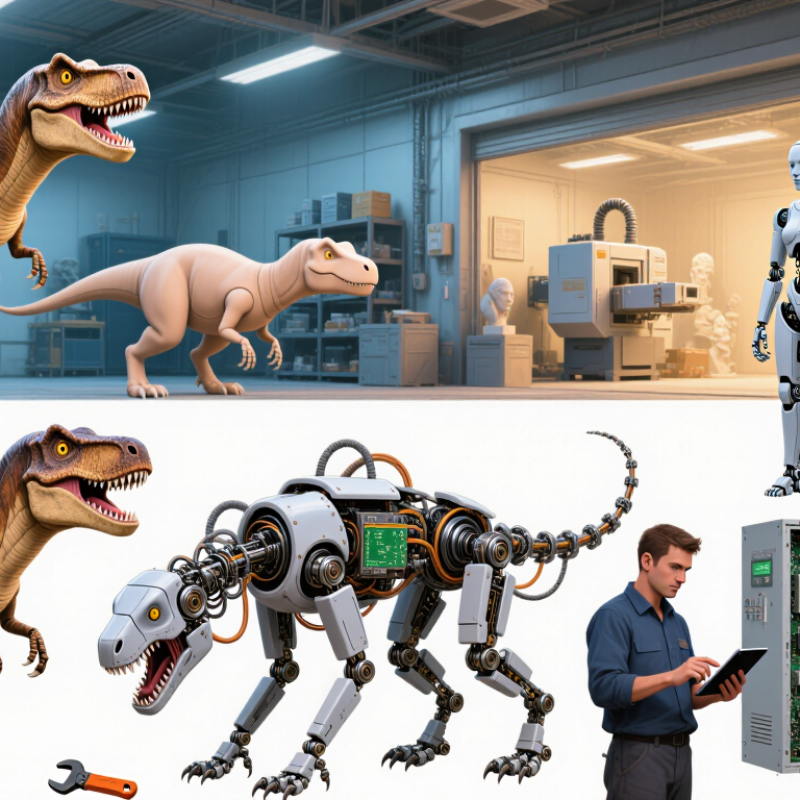
Define Custom Animatronics by Motion, Materials, Controls, and Degrees of Freedom
Custom animatronics should be specified as moving systems, not merely sculpted figures. Describe each motion: head turns, blinking, jaw movement, breathing, or a full-body gesture. Give every action a range, speed, repeat rate, and noise limit. Short movements count. A slight neck tilt may feel more convincing than many dramatic gestures.
Materials shape both appearance and maintenance. Silicone can create soft skin detail, while foam and fabric may reduce weight on larger forms. Specify how surfaces will handle repeated movement, dust, heat, and cleaning. Controls need equal care: define whether scenes run on a timed loop, operator input, or sensor triggers. Also plan access to wiring and actuators. These details are easy to overlook.
Degrees of freedom describe independent axes of movement, but a higher number does not guarantee a better character. IFR’s World Robotics 2024 report recorded about 205,000 professional service robots sold in 2023, a 30% increase. This figure is not an animatronics sales estimate; it signals broader adoption of programmable motion systems. For a custom build, match each axis to a visible purpose. A moving finger may add little from across a room. I would still test the final motion at the actual viewing distance; drawings rarely reveal every awkward pause.
China Top 10 Custom Animatronics Suppliers? Define Custom Animatronics by Motion, Materials, Controls, and Degrees of Freedom
A practical framework for comparing project requirements—not a ranking of suppliers.
Ratings use an illustrative 1–5 planning scale, not supplier-reported measurements. Motion covers the range and type of movement; degrees of freedom (DOF) count independently controlled axes. Controls include actuators, sensors, and sequencing. Common material choices include steel or aluminum frames, foam forms, and silicone or latex skins; the best combination depends on durability, appearance, weight, and environment. Confirm actual specifications with each supplier.
Map 10 Chinese Suppliers by Region, Project Type, and Manufacturing Capability
China’s custom animatronics suppliers are best mapped by region, project type, and verified production capability—not ranking alone. A ten-supplier shortlist could include four Guangdong manufacturers for electronics-rich figures and themed sets, three Jiangsu or Zhejiang workshops for metal frames and precision motion parts, and three suppliers from other manufacturing regions for large scenic builds or installation support. These are screening categories, not proof of any supplier’s capacity. Ask for workshop videos, material specifications, and load-test records.
Project demand is growing, but visitor numbers do not prove demand for animatronics specifically. The 2023 TEA/AECOM Theme Index reported 244.6 million visits across the world’s top 25 theme parks, a 23.5% increase from 2022. Use this as context, not a purchasing forecast. Compare each supplier against your project: a walk-through dinosaur needs robust frames and outdoor finishing; a compact museum figure may need quieter motion and detailed skin work. Regional labels can mislead. I would still verify the actual production line.
Tips: Request one sample motion cycle, close-up seam photos, and a written spare-parts plan before approving a prototype.
Assess Machinery Safety Using ISO 12100 and IEC 60204-1
When evaluating custom animatronics suppliers, treat machinery safety as a design question, not a paperwork exercise. ISO 12100 provides a structured method for identifying hazards, estimating risk, and reducing it through design before relying on warnings. Watch a figure cycle repeatedly: note exposed gears, pinch points, reachable joints, and movement that continues after a control is released. Small details matter.
IEC 60204-1 addresses electrical equipment on machinery, including protection, control circuits, and emergency-stop functions. Ask how the supplier documents wiring, verifies protective bonding, and prevents unexpected restart after power returns. Test the actual installation, not just a clean prototype. Flexible cables near moving limbs can wear; a tidy cabinet does not reveal that.
The ILO’s 2023 report, A Call for Safer and Healthier Working Environments, estimates nearly 3 million work-related deaths and 395 million non-fatal work injuries worldwide each year. Those figures cover many sectors, not animatronics alone, but they underline why risk controls deserve evidence. Request hazard assessments, test records, and clear operating limits. Then check whether operators can reach isolation points without crossing a moving zone. A checklist can still miss a strange real-world use. That deserves a second look.
China Top 10 Custom Animatronics Suppliers? - Assess Machinery Safety Using ISO 12100 and IEC 60204-1
A 10-point safety evaluation framework for comparing suppliers. This is not a supplier ranking; request and verify evidence for each candidate. Suggested weights are an evaluation model, not supplier performance data.
| No. | Assessment dimension | Suggested weight | Relevant standard | Evidence to request and verify |
| 1 | Risk assessment and hazard identification | 15% | ISO 12100 | A documented assessment covering intended use, reasonably foreseeable misuse, setup, operation, maintenance, and decommissioning. |
| 2 | Motion, pinch, crush, and shear hazards | 13% | ISO 12100 | Drawings or inspection records showing how moving joints, linkages, actuators, and accessible gaps are assessed and controlled. |
| 3 | Risk reduction hierarchy | 12% | ISO 12100 | Evidence that design measures are considered first, followed by safeguarding and then user information for residual risks. |
| 4 | Guards, access control, and safety devices | 12% | ISO 12100; IEC 60204-1 where applicable | Guarding and interlock descriptions, installation details, and validation records for safety-related devices included in the machine. |
| 5 | Emergency stop and stopping behavior | 10% | IEC 60204-1; ISO 12100 | Functional test records confirming stop controls, stopping behavior, reset procedure, and any risks caused by loss of power. |
| 6 | Electrical protection and protective bonding | 10% | IEC 60204-1 | Electrical schematics and test results for protective bonding, overcurrent protection, and protection against electric shock. |
| 7 | Control equipment, wiring, and enclosure integrity | 8% | IEC 60204-1 | Electrical drawings, component identification, wiring inspection records, and enclosure details suitable for the stated environment. |
| 8 | Unexpected start-up and isolation for servicing | 8% | ISO 12100; IEC 60204-1 | Documented isolation points and procedures for electrical and other hazardous energy sources during maintenance or adjustment. |
| 9 | Instructions, warnings, and residual-risk information | 6% | ISO 12100; IEC 60204-1 | Operating and maintenance instructions, warning labels, intended-use limits, and clear descriptions of residual risks. |
| 10 | Inspection, testing, and technical documentation | 6% | ISO 12100; IEC 60204-1 | A traceable test and inspection plan, completed records, machine identification, and relevant technical documentation for the delivered configuration. |
| Total suggested weight | 100% | Confirm the applicable standards edition and regulatory requirements for the machine’s destination and use. |
Check Enclosure Protection with IEC 60529 IP Ratings and Prototype Tests
For buyers comparing custom animatronics suppliers, an IP rating is a useful starting point for judging enclosure protection. IEC 60529 defines the rating’s two digits: the first describes protection against solid objects and dust, while the second covers water. Under the standard, IP5X permits limited dust ingress that does not interfere with operation; IP6X requires a dust-tight enclosure. IPX4 addresses splashing water, while IPX5 and IPX6 cover water jets at different levels. These ratings describe specific tests, not every condition a moving figure may face.
Tips: Ask for the exact test level and a report for the assembled prototype. Check seams, cable glands, access panels, and joints around moving parts. Small gaps matter. Repeat testing after opening or servicing the enclosure, since seals can shift during reassembly.
A prototype should be tested in its intended orientation, with its real cables and service covers installed. Record spray direction, duration, and any visible water or dust inside. Then inspect motors, connectors, and control boards; an enclosure can pass a test while a vulnerable connection remains exposed. IEC 60529 provides the test framework, but it does not establish resistance to condensation, repeated motion, or every outdoor exposure. That gap deserves attention. Ask suppliers to document those risks separately, rather than treating an IP code as a complete durability guarantee.