
Blog

China Top 10 Gray Suit Fabric Manufacturers for Global Buyers

China’s textile sector remains a major sourcing base for international apparel buyers. The WTO’s World Trade Statistical Review identifies China as the world’s leading textile exporter. This scale supports broad choices in wool, polyester, viscose, and blended suiting materials. It also creates a difficult problem: quality varies between mills, product lines, and production batches.

This guide examines China’s top 10 Gray Suit Fabric manufacturers for global buyers. Here, “gray” may describe a charcoal or mid-gray color. It may also refer to greige fabric before dyeing and finishing. Buyers should confirm the meaning before requesting quotations. A fabric swatch can look smooth under showroom lighting, yet show pilling after repeated abrasion. Small details matter.

The selection considers manufacturing experience, export capability, fabric consistency, certifications, and customization support. Technical checks include fiber composition, fabric weight, width, colorfastness, shrinkage, and abrasion resistance. ISO 12947 offers a recognized method for testing textile abrasion performance. ISO 105 standards support colorfastness evaluation. These references help buyers compare suppliers more fairly.

Sustainability also deserves attention. Textile Exchange’s Materials Market Report 2024 estimates that global fiber production reached about 124 million tonnes in 2023. It projects continued growth toward 2030. That pressure makes recycled inputs, traceable wool, wastewater management, and energy reporting increasingly relevant. However, sustainability claims still require evidence.

No ranking is perfectly neutral. A large factory is not always the best match for a small brand. Supplier claims should be checked through samples, factory audits, lab reports, and trial orders. The manufacturers below provide a practical starting point for buyers seeking dependable Gray Suit Fabric from China. Procurement still requires judgment.
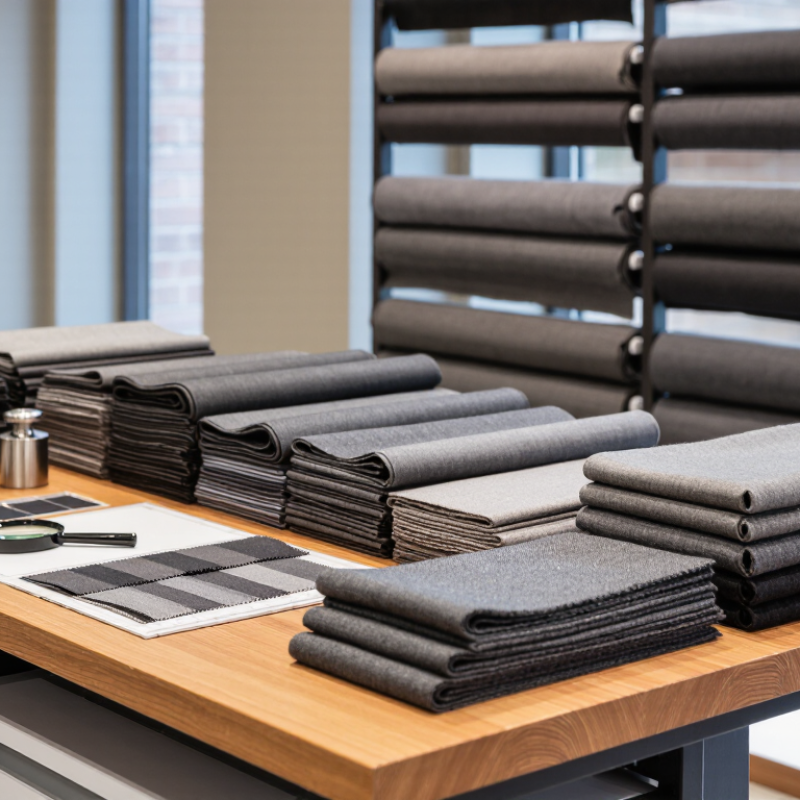
China Top 10 Gray Suit Fabric Manufacturers for Global Buyers

How Gray Suit Fabric Manufacturers Serve Global Apparel Buyers

Gray suit fabric manufacturers serve global apparel buyers through precise specifications, flexible production, and documented quality control. Buyers usually request fabric weight, fiber composition, width, shade tolerance, and finishing details before sampling. A practical gray swatch should show texture under daylight and indoor lighting. It should not hide easily visible slubs.

Textile Exchange’s Materials Market Report 2024 recorded global fiber production at about 124 million metric tons in 2023. The report expects production to reach nearly 160 million metric tons by 2030. This pressure encourages manufacturers to offer recycled fibers, certified wool, and lower-impact dyeing options. However, sustainability claims need test reports, transaction certificates, and traceable shipment records. Vague promises create purchasing risk.

Manufacturers also support buyers with lab dips, pre-production samples, and fabric performance testing. Common checks include colorfastness, pilling, shrinkage, tensile strength, and seam slippage. The International Textile Manufacturers Federation’s 2024 industry survey showed continuing pressure from weak orders and uncertain capacity utilization. This makes realistic lead-time planning essential. A supplier may quote quickly, yet production can still move slowly during peak seasons. That gap deserves more honest communication.

For international orders, experienced mills usually prepare export packing, inspection records, and batch-level shade control. Gray is not one color. It ranges from cool charcoal to warm mid-gray, and small tone changes affect an entire suit collection. Mistakes happen, even with experienced teams. Regular approvals and retained reference samples remain necessary.

Key Criteria for Ranking the Top 10 Gray Suit Fabric Manufacturers

Ranking China’s leading gray suit fabric manufacturers requires more than comparing catalog photographs. Experienced buyers should examine fiber composition, fabric weight, weave density, and shade stability. A gray swatch may appear uniform indoors but reveal uneven tones under daylight. That detail matters.

Independent testing should assess colorfastness, pilling resistance, abrasion performance, tensile strength, and shrinkage after washing or steaming. For tailored suits, a balanced hand feel is essential. The fabric should drape cleanly without feeling lifeless. Manufacturers also deserve higher rankings when they provide recent laboratory reports, traceable batch records, and clear production tolerances. Certification claims must be verifiable, not simply printed on a brochure.

Reliable delivery is another important measure. Review sample approval procedures, minimum order quantities, lead-time accuracy, packaging quality, and responses to technical questions.

A factory visit or third-party audit can reveal storage conditions, inspection routines, and worker training more clearly than online material. Communication counts. A delayed answer can become a delayed shipment.

No ranking is perfect. Small mills may offer stronger craftsmanship but weaker documentation, while larger factories may provide systems without enough flexibility. Buyers should record both strengths and gaps, then compare evidence from several production lots rather than trusting one attractive sample.

Profiles of China’s Top 10 Gray Suit Fabric Manufacturers

China Top 10 Gray Suit Fabric Manufacturers for Global Buyers

The profiles of China’s top ten gray suit fabric manufacturers reveal different strengths rather than one universal standard. Some focus on fine wool blends for formal jackets, while others produce durable polyester-viscose fabrics for uniforms and large-volume orders. Several manufacturers operate modern spinning, weaving, dyeing, and finishing lines under one roof. This can shorten communication and improve shade consistency.

A reliable profile should show more than factory photographs. Buyers should examine fabric composition, weight, width, shrinkage, colorfastness, and pilling results. Leading manufacturers usually provide lab dips, production samples, technical data sheets, and clear minimum order quantities. Some maintain dedicated inspection teams and export departments. Others depend heavily on outside processing, which may create delays. That detail deserves careful questioning. No supplier is perfect.

Tips: Request a one-meter sample before approving bulk production. Compare the gray shade under daylight and indoor lighting. Ask for recent test reports, not old documents. Confirm whether the quoted price includes finishing, packing, and inspection. A small sample can expose uneven texture, weak recovery, or excessive shine. Check lead times against your selling season. Also discuss replacement procedures when fabric fails inspection. These practical checks make the ten manufacturer profiles more useful for global buyers seeking stable quality, transparent service, and realistic production support.

China Top 10 Gray Suit Fabric Manufacturers for Global Buyers

Global Buyer Reference Benchmarks for Gray Suit Fabric

The chart presents commonly used technical reference points for evaluating gray suit fabrics supplied to international buyers. Typical specifications include wool-rich fiber content, medium-weight constructions suitable for year-round tailoring, standard fabric widths, and strong colorfastness and pilling-resistance performance. These are industry reference benchmarks rather than rankings or company-specific results.

Comparing Fabric Quality, Capacity, Pricing, and Export Services

China’s top ten gray suit fabric manufacturers differ sharply in quality, capacity, pricing, and export support. Global buyers should inspect fiber content, yarn count, weave density, and finishing consistency. A reliable mill can provide test reports for colorfastness, pilling, shrinkage, and fabric weight. Ask for production samples from different batches. One perfect swatch proves very little.

Capacity matters when orders grow beyond sampling. Some manufacturers manage large monthly volumes, while others serve smaller, flexible programs. Confirm greige fabric availability, dyeing schedules, inspection procedures, and realistic lead times. Pricing should include finishing, packing, documentation, and port delivery. The lowest quotation may hide weaker recovery after pressing. That risk is easy to underestimate.

Tips: Request a physical sample before approving bulk production. Compare the fabric under daylight and office lighting. Check how it drapes, wrinkles, and returns after gentle pressing. Ask whether recycled fibers or wool blends affect the final price. Export service also deserves careful review. Clear English communication, accurate invoices, compliant labeling, and stable carton packing reduce delays. In my experience, response speed predicts cooperation, but it is not proof of quality. Keep written specifications, because verbal promises can become unclear.c텐츠

How Global Buyers Can Select the Right Gray Suit Fabric Supplier

Selecting a gray suit fabric supplier requires more than comparing catalog photos. Buyers should verify fiber composition, yarn count, fabric weight, width, and finishing records. A charcoal swatch may shift toward green outdoors. Request laboratory dips and production-meter samples before approving bulk orders.

The Textile Exchange Materials Market Report 2024 states that global fiber production reached 124 million tonnes in 2023. Recycled fibers represented 12.5% of total output. This makes traceable material claims commercially important, not decorative. Ask for chain-of-custody documents, certificate scope, and test methods. Check colorfastness, pilling, tensile strength, shrinkage, and seam performance through an independent laboratory. Suppliers with documented experience should explain how they control shade consistency across different dye lots. Still, no audit is perfect. Factory records can be incomplete, and one successful sample proves little.

Tips: Compare at least three suppliers using the same technical specification. Request a gray shade card under daylight and showroom lighting. Confirm minimum order quantity, lead time, replacement policy, and inspection rights in writing. The European Environment Agency’s 2024 textile analysis emphasizes durability and longer product use. Therefore, do not choose only by price. A slightly higher-cost fabric may reduce returns, complaints, and premature replacement. Ask difficult questions early. That is often where reliability becomes visible.

China Top 10 Gray Suit Fabric Manufacturers for Global Buyers - How Global Buyers Can Select the Right Gray Suit Fabric Supplier

Buyer-oriented comparison of anonymized manufacturer profiles and commonly specified gray suiting-fabric parameters

Rank Anonymous Manufacturer Profile Primary Production Area Typical Gray Suit Fabric Construction Fiber Composition Fabric Weight Usable Width Common MOQ Standard Bulk Lead Time Quality & Compliance Documents Best Buyer Fit Selection Score
01 Profile A — Integrated Wool Mill Jiangsu, China 2/2 twill; worsted finish; solid gray and subtle melange options 100% wool or 70% wool / 30% polyester 250–300 g/m² 150–155 cm 300–500 metres per colour 35–50 days OEKO-TEX® Standard 100 or equivalent; colourfastness; shrinkage; pilling reports Premium tailoring, uniforms and four-season suiting 9.3 / 10
02 Profile B — High-Volume Suiting Mill Zhejiang, China Poly-viscose twill; plain gray, charcoal and graphite shades 65% polyester / 35% viscose 240–280 g/m² 148–150 cm 500–1,000 metres per colour 30–45 days ISO 9001 quality system; colourfastness; dimensional stability; abrasion testing Large uniform programs and value-focused retailers 9.1 / 10
03 Profile C — Recycled-Fiber Specialist Fujian, China Fine twill and micro-textured suiting with recycled content 55% recycled polyester / 45% viscose 230–270 g/m² 150–152 cm 300–600 metres per colour 40–55 days GRS transaction documentation when applicable; recycled-content verification; colourfastness reports Sustainability-led brands and corporate apparel 8.9 / 10
04 Profile D — Wool-Blend Performance Mill Shandong, China Stretch twill with crease-recovery and easy-care finishing 50% wool / 48% polyester / 2% elastane 260–290 g/m² 150 cm 500–800 metres per colour 35–50 days Dimensional stability; stretch recovery; pilling; colourfastness and formaldehyde testing Travel suits, workwear and performance tailoring 8.8 / 10
05 Profile E — Custom-Dyeing Specialist Guangdong, China Poly-viscose plain weave and twill; custom gray shade matching 60% polyester / 40% viscose 210–260 g/m² 145–150 cm 200–400 metres per colour 25–40 days after colour approval Lab-dip approval; spectrophotometer colour data; colourfastness and shrinkage reports Private-label collections requiring flexible colour development 8.7 / 10
06 Profile F — Lightweight Suiting Mill Hubei, China Lightweight tropical weave and fine twill for warm climates 55% polyester / 45% viscose 180–220 g/m² 148–150 cm 300–500 metres per colour 30–45 days Air permeability; colourfastness; pilling; dimensional stability documentation Spring/summer suits and tropical-market programs 8.5 / 10
07 Profile G — Recycled Polyester and Viscose Mill Anhui, China Compact twill with matte surface and low-shine appearance 50% recycled polyester / 50% viscose 240–280 g/m² 150–152 cm 500–1,000 metres per colour 40–60 days GRS or equivalent recycled-content records; abrasion; pilling; colourfastness reports Mid-market programs with recycled-material targets 8.4 / 10
08 Profile H — Small-Batch Development Mill Shanghai, China Custom melange, birdseye and subtle check constructions Polyester/viscose blends; wool blends available by order 220–300 g/m² 145–150 cm 100–300 metres per colour 35–55 days Pre-production sample approval; shade band; shrinkage; pilling and seam-slippage reports Boutique labels and seasonal capsule collections 8.2 / 10
09 Profile I — Uniform Fabric Producer Hebei, China Durable poly-viscose twill with consistent bulk shade matching 70% polyester / 30% viscose 250–310 g/m² 150 cm 800–1,500 metres per colour 30–50 days ISO 9001; abrasion; tear strength; colourfastness; dimensional stability documentation Government, hospitality, security and institutional uniforms 8.0 / 10
10 Profile J — Entry-Level Suiting Mill Henan, China Basic plain weave and twill for economical gray suiting 80% polyester / 20% viscose 200–240 g/m² 145–150 cm 500–1,000 metres per colour 25–40 days Basic colourfastness, shrinkage and composition testing; buyer inspection recommended Promotional apparel and cost-sensitive volume orders 7.8 / 10

Buyer verification note: The figures shown are realistic market benchmarks for Chinese gray suiting-fabric production and should be confirmed against each supplier’s current technical sheet, sample approval, certification scope, test reports, production capacity and written commercial quotation before purchase.