
Blog

Top 10 Dispensary Display Cases for Global Retailers

Choosing the right dispensary display cases involves more than comparing glass, locks, and price tags. Global retailers need fixtures that protect merchandise, support lawful sales, and create a clear customer experience. A well-designed case can make product details visible without creating glare. It can also help staff maintain accurate inventory and clean presentation standards.

This guide reviews ten display solutions for authorized retail environments. Each option is considered through practical retail experience, construction quality, accessibility, lighting, security, and maintenance. Materials matter. Tempered glass, durable metal frames, concealed hinges, and reliable locks can improve daily performance. Adjustable shelves may also support changing product sizes and seasonal campaigns.

Small details matter.

A case placed near a busy entrance may need stronger security and a wider viewing angle. A counter case may suit compact stores, but it can restrict customer movement. Bright lighting can attract attention, yet excessive brightness may distort colors or create uncomfortable reflections. These details are easy to overlook.

No single design fits every market. Local building rules, accessibility requirements, privacy expectations, and retail regulations must guide the final choice. Retailers should verify specifications with qualified professionals before installation. That step may seem slow, but replacing unsuitable fixtures costs more.

The following selection highlights dispensary display cases that balance presentation, durability, customer trust, and operational control. Some designs are highly polished. Others are more practical than beautiful. That difference deserves honest consideration.
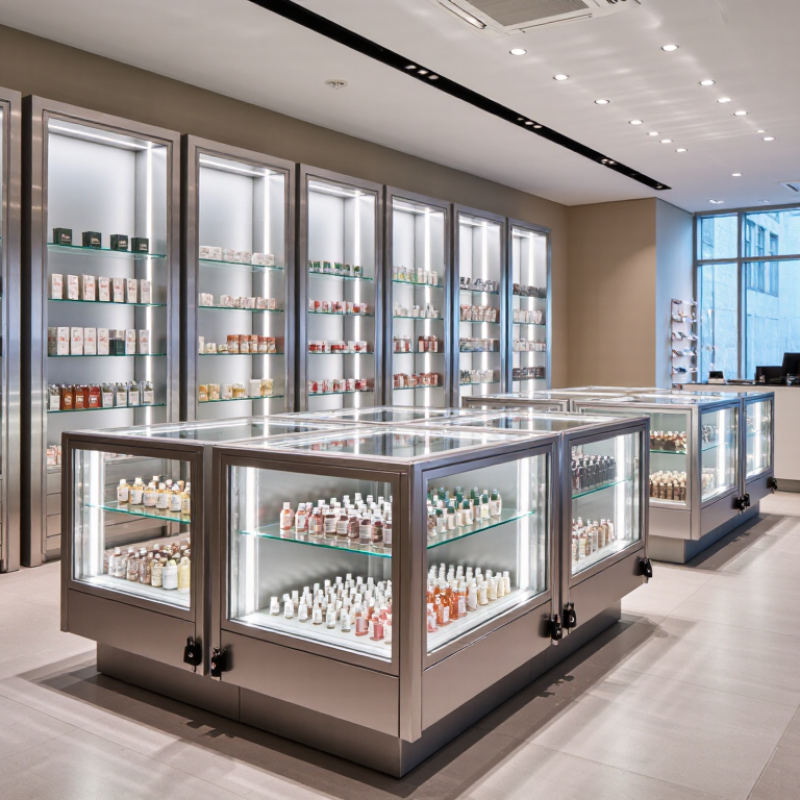
Top 10 Dispensary Display Cases for Global Retailers

Dispensary Display Cases: Definition, Functions, and Retail Applications

Top 10 Dispensary Display Cases for Global Retailers

Dispensary display cases are secure retail fixtures designed to present regulated, high-value merchandise clearly. They combine visibility, controlled access, lighting, and product protection. A well-designed case may include tempered glass, adjustable shelving, locks, ventilation, and concealed cable channels. These details support safer operations and a cleaner customer experience.

In retail applications, display cases help staff manage demonstrations and product comparisons. Clear sightlines let customers examine packaging without unnecessary handling. Locking doors reduce loss risks, while modular shelves support different product sizes. Low-glare LED lighting can improve label readability. However, bright lighting may create reflections and distort colors. Store testing matters.

From practical retail planning, the best ten case options should be compared by durability, accessibility, maintenance, and local compliance requirements. Countertop units suit smaller locations. Freestanding cases create stronger visual zones. Wall-mounted designs save floor space but may limit stock capacity. Temperature and humidity controls can be useful for sensitive lawful merchandise, though they increase maintenance needs. Keep cleaning simple. Dust collects quickly around hinges and vents.

A perfect case does not exist. Poorly positioned locks can slow service. Excessive security can make a store feel unwelcoming. Retailers should review customer movement, staff reach, lighting, and emergency access before ordering. A short in-store trial often reveals problems that drawings miss. That practical step is easy to overlook.

Global Market Context: 228 Million Cannabis Users in 2022 (UNODC)

Top 10 Dispensary Display Cases for Global Retailers

Global Market Context: 228 Million Cannabis Users in 2022 (UNODC)

The UNODC reported 228 million cannabis users worldwide in 2022. This figure shows significant market demand, but it does not remove local responsibilities. Retailers must follow regional laws, age restrictions, product rules, and advertising limits. A reliable display case should support compliance, not simply attract attention. Strong options include lockable glass cabinets, modular wall cases, counter displays, and illuminated units with controlled brightness. Clear sightlines help staff monitor products and assist customers without unnecessary handling.

From practical retail projects, the best cases combine security, accessibility, and easy cleaning. Tempered glass improves visibility. Concealed hinges reduce tampering risks. Adjustable shelves support different packaging sizes. Neutral lighting prevents misleading color changes. Yet, early layouts often focused too much on appearance. That was a mistake. Customers also need readable information, comfortable viewing height, and enough space for staff movement. A perfect case does not exist; store conditions always require adjustment.

Tips: Measure the sales floor before selecting a case. Check door clearance, power access, cleaning routines, and emergency movement paths. Use consistent labels and plain language. Review lighting with real packaging, not only digital images. Ask local compliance professionals to verify the final layout. Global retailers should also test accessibility with different customers and staff members. Small design flaws become expensive when repeated across many locations.

Ten Display Case Types Ranked by Security, Visibility, and Capacity

Top 10 Dispensary Display Cases for Global Retailers

Ten Display Case Types Ranked by Security, Visibility, and Capacity

Retailers need display cases that protect regulated wellness and over-the-counter products without hiding them. Based on store planning experience, these ten formats offer different strengths.

1. Locking glass towers provide excellent security, strong visibility, and moderate capacity. 2. Wall-mounted cabinets save floor space and offer high security, but visibility can suffer. 3. Countertop cases support close staff supervision and quick service. Their capacity remains limited. 4. Sliding-glass cases balance access control, viewing space, and medium capacity. 5. Modular showcases adapt to changing product ranges and store layouts. Security depends on the lock quality. 6. Drawer-style cabinets protect small items efficiently, though shoppers see fewer products at once. 7. Rotating towers create strong visual movement and use limited floor space. They hold less stock than expected. 8. Freestanding island cases improve customer access and product comparison, but require careful placement. 9. Backlit cases increase visibility in dim interiors and highlight packaging details. Bright lighting may create reflections. 10. Under-counter cases maximize storage and protect reserve inventory, but they offer almost no direct visibility.

Security begins with laminated glass, concealed hinges, and tested locks. Visibility improves through adjustable lighting, clear sightlines, and uncluttered shelves. Capacity depends on shelf depth, product size, and replenishment routines. Measure twice. Small gaps become expensive later. Retail teams should test door movement during busy periods and review staff reach, cleaning time, and emergency access. One design may look perfect on a drawing and feel awkward in daily operation. That is worth noticing.

Safety and Compliance: UL 962, EN 14749, and Accessibility Standards

Top 10 Dispensary Display Cases for Global Retailers

Safety begins with the case, not the sales floor. For regulated retail environments, each display unit should support secure, accessible, and well-documented operations. When a case includes lighting, outlets, or electronic controls, confirm whether UL 962 applies to its construction and intended use. Scope matters. A familiar label does not automatically cover every configuration.

European projects require similar care. EN 14749 can guide evaluations for storage furniture, including stability, strength, and safety-related construction details. Test the assembled case, not only individual panels. Check door movement, shelf loading, sharp edges, glazing, and anchoring. A small gap near a hinge can become a repeated hand injury risk. It should be corrected before installation.

Accessibility deserves equal attention. Provide usable approach space, reachable controls, readable information, and clear sightlines for seated and standing visitors. Avoid high shelves, heavy doors, slippery floor transitions, and handles that require excessive force. Local accessibility rules may differ, so qualified review remains necessary. A certificate alone is not enough. In practical audits, teams sometimes focus on locks and overlook glare, reach distance, or wheelchair turning space. That oversight is easy to repeat. Document measurements, inspection dates, materials, and maintenance checks. Then ask a difficult question: can every visitor use the display safely without assistance?

Selection Metrics: Cost, Durability, Merchandising, and Store Footprint

For global dispensary retailers, a display case is a sales tool, not merely a locked box. Selection should begin with four measurable filters: landed cost, durability, merchandising value, and footprint. The Global Wellness Institute valued the wellness economy at $6.3 trillion in 2023, increasing pressure to present products clearly. That scale does not justify overspending on glass.

Cost includes freight, installation, lighting, cleaning, and replacement hardware. A low purchase price can become expensive after one damaged hinge. The 2023 National Retail Security Survey reported average retail shrink of 1.6% of sales in 2022. Choose tempered panels, anchored frames, controlled access, and unobstructed sightlines. Security should not make staff demonstrate every item. That slows service.

Merchandising needs adjustable shelves, neutral lighting, and front clearance for comfortable browsing. The U.S. Energy Information Administration’s 2018 Commercial Buildings Energy Consumption Survey found lighting represented 17% of commercial building electricity use. Efficient LEDs deserve a lifecycle-cost test. Measure each case against the store footprint, queue path, accessibility, and circulation space. Leave room for seasonal resets. A beautiful case can still fail. I would pilot one bay for four weeks, recording dwell time, cleaning minutes, stock visibility, and staff complaints. The last metric is imperfect, but ignoring it is worse.

Top 10 Dispensary Display Cases for Global Retailers - Selection Metrics: Cost, Durability, Merchandising, and Store Footprint

Rank Display Case Type Indicative Cost
per Unit (USD)
Typical Width Durability
Rating
Construction and Security Merchandising Capacity Store Footprint Access and Visibility Best Retail Use
1 Modular Glass Counter Case $650–$1,400 36–48 in ★★★★★
High
Tempered glass, powder-coated steel or aluminum frame, keyed or electronic lock options. 18–36 small packaged items; adjustable shelves support frequent assortment changes. Low; suitable for checkout counters and consultation desks. Excellent product visibility; staff-assisted access. High-value packaged products and accessories.
2 Freestanding Tower Case $900–$2,200 24–36 in ★★★★★
High
Tempered glass panels, reinforced frame, lockable hinged or sliding door. 30–70 items across five to seven vertical shelves. Small floor area; uses vertical space efficiently. 360-degree or three-sided viewing, depending on configuration. Hero products, premium collections, and educational displays.
3 Wall-Mounted Display Cabinet $550–$1,300 30–72 in ★★★★☆
Very high
Aluminum or steel frame, laminated back panel, tempered glass, concealed mounting hardware. 20–60 items with two to four adjustable shelves. Very low floor usage; requires suitable wall reinforcement. Strong front-facing visibility; staff-assisted access. Compact stores and wall-based category merchandising.
4 Lockable Sliding-Door Case $750–$1,700 48–72 in ★★★★☆
Very high
Tempered sliding glass, aluminum track system, central lock, impact-resistant base. 40–90 items; wide shelf span supports category grouping. Moderate; works well along perimeter walls or counters. Good visibility with controlled opening access. High-volume assortments and regulated product presentation.
5 Illuminated Curved-Glass Case $1,100–$2,800 48–72 in ★★★★☆
Very high
Curved tempered glass, steel base, integrated low-voltage LED lighting, lockable access. 30–60 items; curved front creates a premium presentation zone. Moderate to high; requires dedicated floor or counter placement. Excellent visibility and strong visual impact from multiple angles. Premium products, limited editions, and brand-neutral feature displays.
6 Mobile Lockable Merchandising Cart $450–$1,200 24–36 in ★★★☆☆
Good
Lockable acrylic or glass enclosure, steel body, four heavy-duty casters with brakes. 15–35 items; compact shelves or pegboard inserts allow flexible layouts. Small and relocatable; useful where floor plans change often. High visibility; access can be staff-controlled. Seasonal promotions, events, and flexible store layouts.
7 Acrylic Security Display Case $180–$650 18–36 in ★★★☆☆
Good
Clear acrylic panels, lightweight metal frame, hinged lid or lockable door. 8–25 small items; best for focused or low-volume assortments. Very low; suitable for counters, shelves, and small consultation areas. Very high visibility; quick staff access. Entry-level displays and small packaged products.
8 Under-Counter Pull-Out Case $600–$1,500 30–48 in ★★★★☆
Very high
Steel drawer or cabinet body, full-extension runners, lockable front, reinforced countertop compatibility. 20–45 items stored in divided trays or adjustable compartments. Minimal; uses otherwise inactive counter volume. Low customer visibility; excellent controlled staff access. Secure storage and discreet consultation-led selling.
9 Freestanding Gondola Case $1,000–$2,600 36–48 in ★★★★☆
Very high
Steel carcass, tempered glass doors, adjustable shelving, optional lock and cable management. 50–110 items across both sides or a single large-facing side. Moderate to high; requires aisle clearance and stable placement. Strong two-sided visibility when configured as an island unit. Large-format stores and high-throughput category zones.
10 Refrigerated Display Case $2,000–$6,500 36–72 in ★★★★☆
Very high
Insulated glass, commercial refrigeration system, stainless or coated steel interior, lockable doors where required. 30–90 temperature-sensitive products, depending on shelf count and case length. High; requires power, ventilation, and service clearance. Excellent visibility with optional internal LED lighting. Temperature-sensitive products and controlled cold-chain merchandising.

Cost figures are indicative 2025–2026 USD market ranges for commercial display equipment and may vary by size, materials, locking system, lighting, shipping, installation, electrical requirements, and local compliance standards. Durability ratings are comparative assessments based on typical commercial construction, glass specification, frame materials, and expected retail use.