
Blog
Top Pixel Art Beads Suppliers for Global Buyers
Pixel Art Beads are no longer limited to small hobby shops or local craft fairs. They now support keychains, framed mosaics, jewelry, educational kits, and customized gifts. For global buyers, however, attractive colors are only the starting point.
Grand View Research valued the global arts and crafts market at approximately USD 43.3 billion in 2023. It also forecasts steady growth through 2030. This broader market signals stronger demand for reliable craft supplies, including Pixel Art Beads. The Craft Industry Alliance has similarly reported sustained consumer interest in hands-on, screen-free creative activities. The figures are useful. They are not perfect. Market reports often group beads with wider craft categories, which can hide important product differences.
Beadwork educator Diane Fitzgerald offers a practical reminder: “The bead is small, but the design is not.” Her point applies directly to international purchasing. A one-millimeter size variation can distort a character’s eyes. Uneven holes can slow production. Weak color consistency can make two finished panels look unrelated.
This guide evaluates leading Pixel Art Beads suppliers through product uniformity, material disclosure, color range, packaging, minimum order quantities, customization, and export experience. Samples should be tested before large orders. That step is easy to skip. It is also where many costly assumptions begin.
The strongest suppliers combine dependable manufacturing with clear communication. They provide batch information, responsive support, and packaging that protects tiny beads during long-distance shipping. Buyers should still verify every claim independently. Supplier rankings can guide decisions, but direct sample inspection remains the more reliable measure.
Types of Pixel Art Beads and Their Common Uses
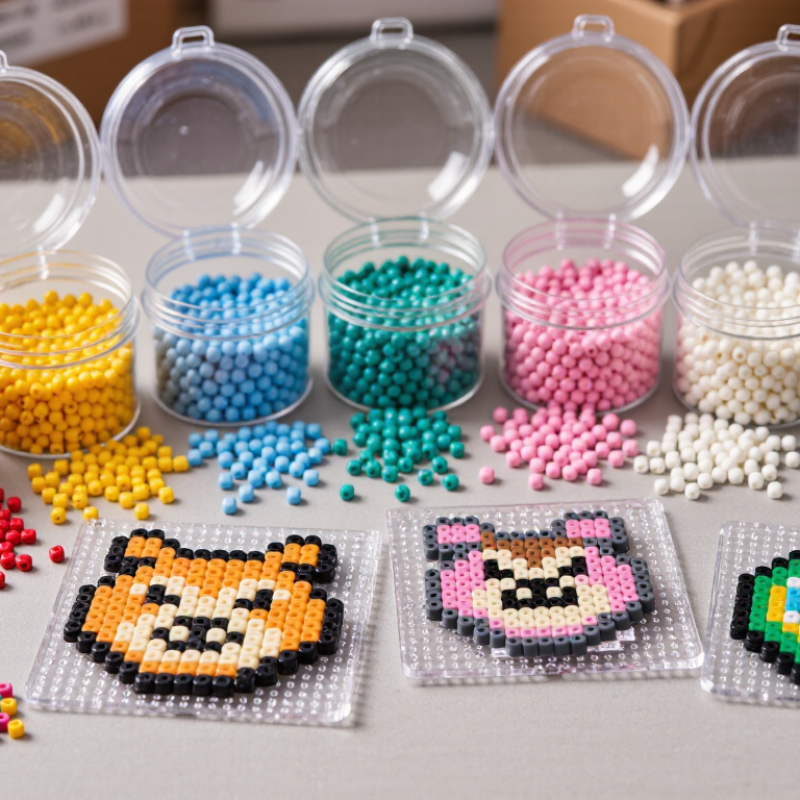
Pixel art beads come in several practical sizes. Standard midi beads, about five millimeters wide, suit beginners and larger wall designs. Mini beads create sharper details for portraits, icons, and compact accessories. Larger beads are easier for small children to handle. Always match bead size with the correct pegboard. They are not interchangeable.
Material and finish also affect the result. Opaque beads produce solid color blocks and clear outlines. Transparent beads add a glass-like effect to windows, water, and light effects. Metallic, pastel, glow, and mixed-color beads support more expressive patterns. Fuse beads are commonly arranged on pegboards and joined with controlled heat. Pony-style beads work better for bracelets, lanyards, keychains, and hanging decorations. They usually have larger holes for thread or elastic.
Common uses include fridge magnets, bag charms, ornaments, desk decorations, and classroom activities. Makers can teach counting, symmetry, color planning, and hand coordination through small projects. Global buyers should check color consistency, bead dimensions, packaging strength, and safety documentation before ordering. Sample testing matters. A slightly uneven bead can disturb an entire grid. My early color charts looked accurate, but finished pieces sometimes appeared darker under indoor light. That mistake taught me to test colors beside the intended display area. Suppliers should also provide clear size information, batch details, and careful packing for international transport.
| Bead Type | Typical Material | Common Size Range | How It Is Assembled | Common Uses | Key Buying Considerations | Typical Buyer Group |
|---|---|---|---|---|---|---|
| Heat-Fusible Craft Beads | Colored thermoplastic, commonly polyethylene or a similar craft-grade polymer | Approximately 2.5 mm to 5 mm in diameter | Placed on a pegboard and joined with heat from an iron through protective paper | Pixel art magnets, ornaments, keychains, coasters, wall decorations, and educational craft projects | Color consistency, controlled melting behavior, bead-hole uniformity, and compatibility with pegboards | Craft retailers, schools, hobby shops, online craft sellers, and DIY consumers |
| Mini Fuse Beads | Small-format thermoplastic polymer | Approximately 2 mm to 2.5 mm in diameter | Heat-fused on a fine-grid pegboard, usually with tweezers or a precision placement tool | Detailed sprites, miniature portraits, jewelry components, phone charms, and small decorative scenes | High placement precision, pegboard grid accuracy, color availability, and packaging that prevents mixing | Advanced hobbyists, miniature-art creators, jewelry makers, and specialist craft stores |
| Large Fuse Beads | Thermoplastic polymer designed for easier handling | Approximately 5 mm to 6 mm in diameter | Arranged on a large-grid pegboard and fused with moderate heat | Beginner projects, preschool and classroom activities, simple animals, large icons, and basic ornaments | Ease of handling, child-appropriate design, heat-setting instructions, and edge stability after fusing | Schools, families, children’s activity centers, and beginner craft programs |
| Iron-On Pixel Beads | Heat-reactive plastic beads with a hollow center | Usually sold in standardized craft sizes matched to a pegboard system | Fused by applying heat evenly over ironing paper; the finished piece may be fused on one or both sides | Flat pixel illustrations, game-inspired decorations, badges, coasters, and seasonal crafts | Melting temperature guidance, paper quality, bead adhesion, and resistance to over-heating | General craft buyers, gift shops, educational suppliers, and seasonal merchandise makers |
| Transparent or Translucent Beads | Clear or semi-transparent thermoplastic polymer | Available in several standard fuse-bead diameters | Placed and heat-fused like opaque beads; light can pass through the finished design | Window hangings, light-catching ornaments, stained-glass-style motifs, and layered artwork | Clarity, color stability, surface finish, and visual appearance after heat exposure | Decorative-art makers, seasonal craft businesses, classrooms, and home décor sellers |
| Glow or Fluorescent Beads | Polymer containing light-reactive or fluorescent additives | Commonly offered in standard and mini fuse-bead sizes | Arranged on a pegboard and fused using the same general process as other heat-fusible beads | Night-themed decorations, party favors, children’s crafts, signs, and accent details in pixel art | Brightness, charging requirements, color stability, and performance after repeated exposure to light | Party-supply sellers, activity providers, hobbyists, and novelty craft retailers |
| Mixed-Color Bead Sets | Assorted thermoplastic beads in multiple colors | Frequently packaged in standard, mini, or large formats | Sorted by color and placed on a compatible pegboard before heat fusion | Starter kits, classroom projects, pattern recreation, seasonal designs, and gift bundles | Color count, quantity per color, sorting method, resealable packaging, and pattern support | Craft-kit wholesalers, schools, retailers, subscription boxes, and first-time users |
| Single-Color Bulk Beads | Uniform thermoplastic beads in one selected color | Usually supplied in standard craft sizes for repeat production | Used with a compatible pegboard and fused individually or as part of a larger design | High-volume production, pixel murals, repeated motifs, branded color schemes, and workshop replenishment | Batch consistency, color matching, weight accuracy, packaging efficiency, and reliable replenishment | Professional makers, workshop organizers, craft manufacturers, and wholesale distributors |
| Beads for Three-Dimensional Builds | Heat-fusible plastic selected for structural rigidity after assembly | Most commonly standard-size beads, sometimes combined with mini beads for detail | Individual flat panels are fused and connected using interlocking tabs, adhesive, or additional assembly methods | Small figures, display models, cubes, containers, game-inspired sculptures, and architectural forms | Panel strength, dimensional accuracy, warping control, assembly method, and design compatibility | Experienced artists, exhibition makers, educational programs, and custom décor businesses |
| Pre-Sorted Pattern Packs | Heat-fusible beads packaged with a printed or digital design guide | Size depends on the included project and pegboard format | Beads are placed according to a color-coded pattern and fused after completion | Guided workshops, beginner kits, themed gifts, classroom lessons, and licensed-design alternatives without brand identification | Pattern clarity, accurate bead counts, included pegboard, instruction language, and packaging protection | Gift retailers, schools, event organizers, craft subscription services, and leisure consumers |